|
Induction of anesthesia
Our patients are then given an injection intravenously, through the catheter, of a fast-acting short anesthetic agent. This is the time in human anesthesia when they ask you to count backward from 100 (and you rarely make it past 98). Within one to two minutes our patient is anesthetized. This is called induction of anesthesia.
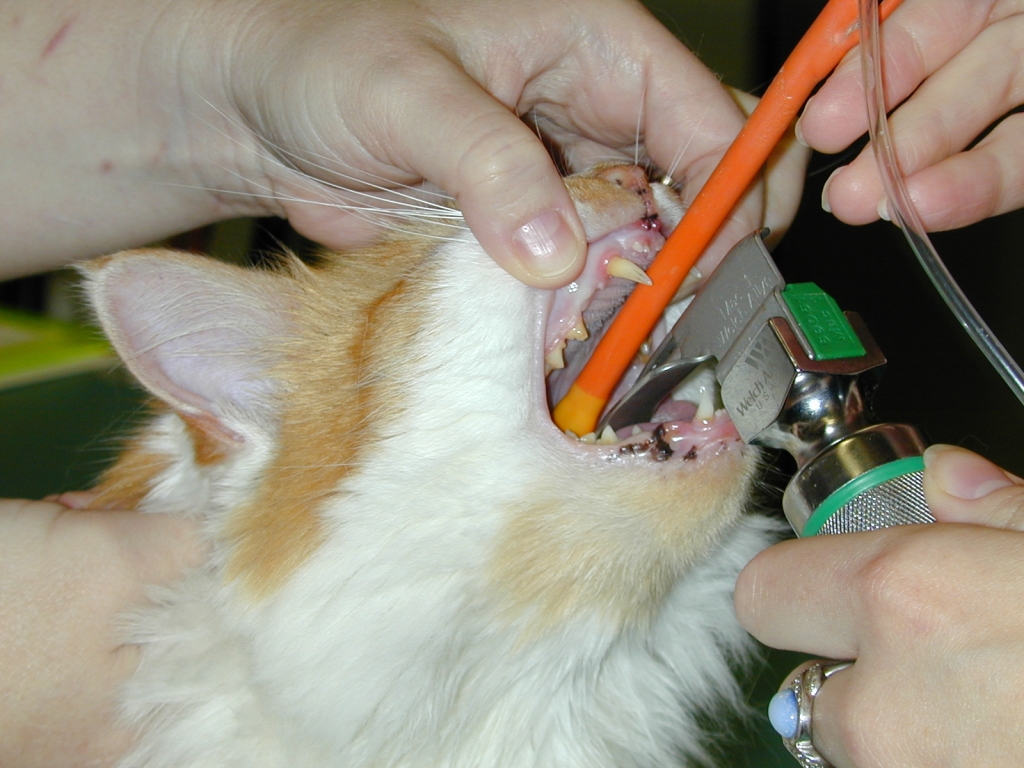 Then we intubate. A tube is passed down the throat, between the vocal cords and into the trachea (windpipe). The picture on the left show us passing an orange endotracheal tube into the trachea. (The cat is completely anesthetized by the induction injection and does not feel anything at this point.) This endotracheal tube is then hooked up to an anesthetic machine, which delivers a mixture of oxygen and an anesthetic gas (typically isoflurane) right to the lungs. Then we intubate. A tube is passed down the throat, between the vocal cords and into the trachea (windpipe). The picture on the left show us passing an orange endotracheal tube into the trachea. (The cat is completely anesthetized by the induction injection and does not feel anything at this point.) This endotracheal tube is then hooked up to an anesthetic machine, which delivers a mixture of oxygen and an anesthetic gas (typically isoflurane) right to the lungs.
Pets are kept anesthetized for the duration of the surgery by the inhaled isoflurane. One of the advantages to isoflurane is safety we are able to change the depth of anesthesia relatively quickly and easily. This is a degree of control that we cannot get using injectable anesthetics alone.
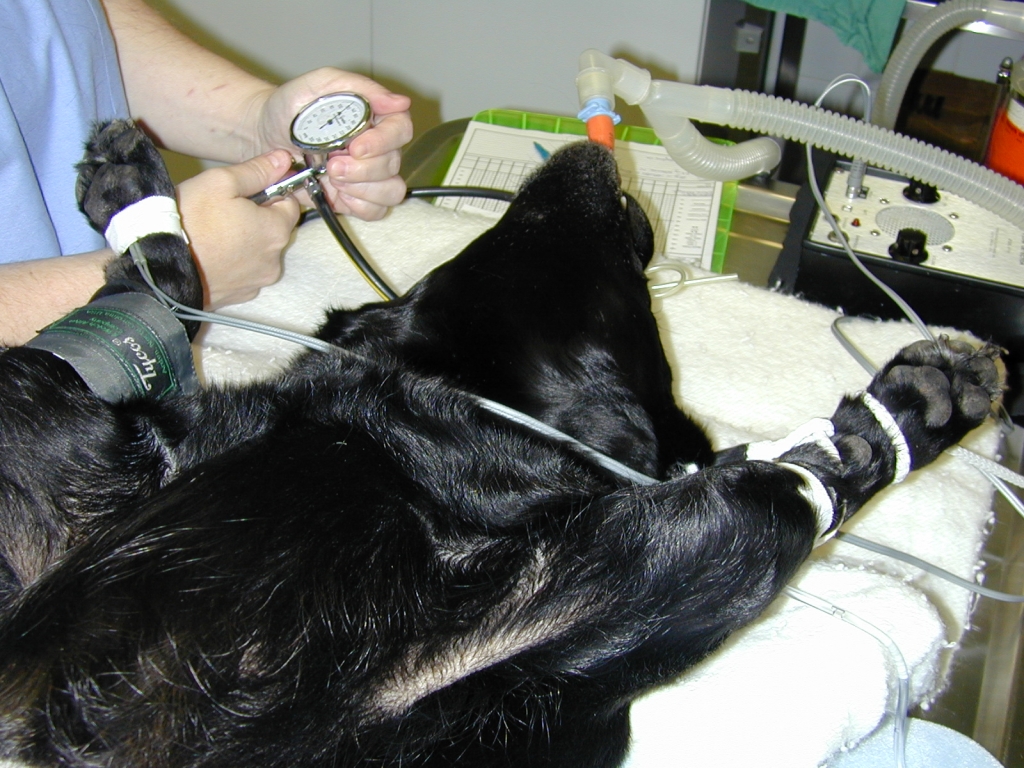 Once the patient is stable on the anesthetic machine they are connected to heart and blood pressure monitors. We shave a small spot on the back of one of the front legs just above the paw; this is where the doppler probe for the blood pressure is placed on the skin. For the entire time that the pet is under anesthesia a veterinarian or Registered Veterinary Technologist (RVT) supervises monitoring of blood pressure, pulse, heart rate, respiratory rate, and depth of anesthesia. The picture to the right shows a dog with the doppler probe taped to the back of the foot and a grey blood pressure cuff around the leg. The box in the upper right is the doppler speaker. The dog's other leg has the IV catheter and IV line taped in. Once the patient is stable on the anesthetic machine they are connected to heart and blood pressure monitors. We shave a small spot on the back of one of the front legs just above the paw; this is where the doppler probe for the blood pressure is placed on the skin. For the entire time that the pet is under anesthesia a veterinarian or Registered Veterinary Technologist (RVT) supervises monitoring of blood pressure, pulse, heart rate, respiratory rate, and depth of anesthesia. The picture to the right shows a dog with the doppler probe taped to the back of the foot and a grey blood pressure cuff around the leg. The box in the upper right is the doppler speaker. The dog's other leg has the IV catheter and IV line taped in.
Next - Surgical prep
| 

 Processing ....